Last updated: June 2026.
This is not a product review or a buying guide. It is an honest look at where things stand right now: what changed, why it happened, and what it means for the way people watch IPTV in the second half of 2026 and beyond.
1 Three pressures arriving at once
Most disruptions to the IPTV ecosystem arrive one at a time. A provider shuts down. An app gets pulled. A hardware manufacturer tightens restrictions. Users adapt, find alternatives, and the ecosystem rebalances.
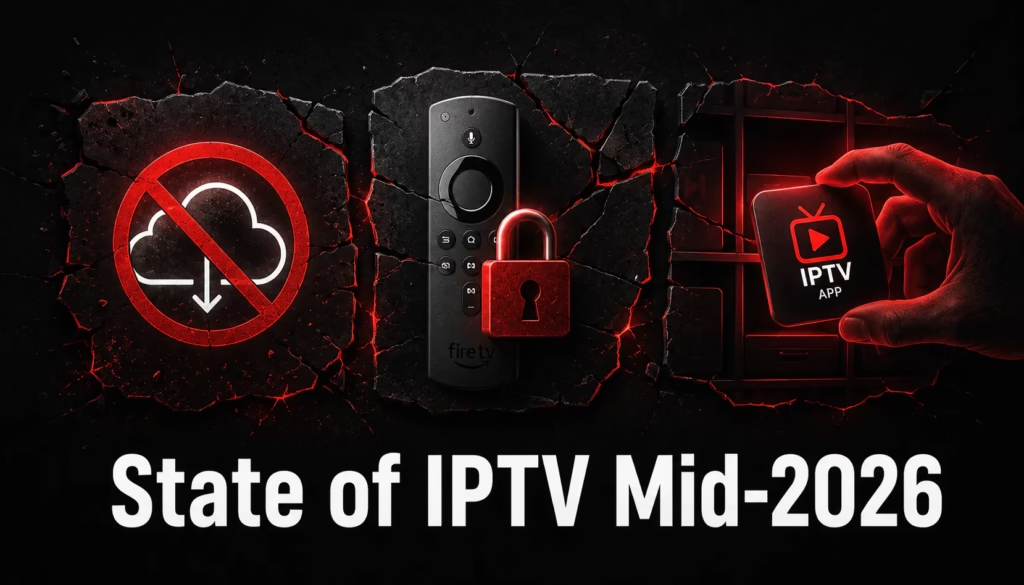
Mid-2026 is different because three significant changes landed within roughly a two-month window, and they are each attacking a different layer of how people actually use IPTV:
- The content layer: Real-Debrid, the most widely used debrid service, implemented a keyword-based content filter in May 2026 that removed access to a large portion of its cached library overnight.
- The hardware layer: Amazon confirmed in April 2026 that all future Fire TV Stick models will run Vega OS, its Linux-based replacement for Android, on which sideloading is permanently blocked.
- The software layer: Multiple IPTV player apps have been removed from Google Play, the Samsung Tizen store, and the LG Content Store in 2025 and 2026, shrinking the range of apps available through official channels.
None of these developments is catastrophic on its own. But because they are happening simultaneously, and because each one closes off a different workaround, the combined effect is more significant than any single story suggests.
2 The Real-Debrid filter: what actually happened
Real-Debrid has been the default debrid service for Stremio and Kodi users for years. The proposition is simple: pay a modest monthly or annual fee, and access a large cache of pre-downloaded torrent content at high speed without seeding, without waiting, and without peer-to-peer exposure. For most users it worked seamlessly for a long time.
That changed on or around May 10, 2026, when Real-Debrid began returning copyright-infringement errors on a large category of cached content. This was not a server outage. Subscriptions remained active. The service was online. The problem was that a significant portion of the cached library became inaccessible.
What was blocked: The filter targets filename patterns common to the vast majority of scene and P2P releases: WEB-DL, WEBRip, AMZN, NF, CR, YTS, RARBG, and similar release-group tags. Because these naming conventions are nearly universal, the practical effect was much broader than blocking specific titles.
Third-party estimates put the effective library loss at 50 to 70 percent of previously accessible content. Real-Debrid did not announce the change in advance.
Real-Debrid’s parent company, XT Network, stated that the filtering system was implemented to comply with France’s Digital Services Act obligations and in response to keyword lists submitted by rights-holder representatives acting as trusted flaggers under Article 16 of the DSA. The company also cited a March 2026 Paris Court of Appeal ruling that, in its view, limits the scope of general monitoring obligations placed on technical intermediaries.
Around the same time, XT Network went through a corporate restructuring: its registered office moved from Levallois-Perret to Montreuil in late April, and the company changed its legal form from an SARL to an SAS under French corporate law. These changes are publicly verifiable through the French company registry. Whether they are connected to the filtering decision is not confirmed.
The practical situation today: Real-Debrid still works for older, niche, and foreign-language content where its deep historical cache has no equivalent. For mainstream recent releases in common formats, availability is substantially reduced compared to 12 months ago. The filter has not been reversed as of the date of this post. See our full Real-Debrid filtering explainer for more detail.
It is also worth noting that the Real-Debrid filter is irrelevant to a large portion of IPTV users for a reason beyond the direct-subscription point made above: most IPTV subscriptions include substantial on-demand libraries delivered directly from the provider’s own servers. RealmIPTV carries over 150,000 VOD titles, Xtreme HD IPTV similarly. That content is entirely unaffected by the Real-Debrid situation. If you were using a debrid service primarily for on-demand films and TV rather than live streams, a well-stocked IPTV subscription covers much of the same ground without any of the current uncertainty.
What users are doing about it
The most common response has been to move to TorBox as a primary debrid service, either replacing Real-Debrid entirely or running both in parallel. TorBox has no equivalent keyword filter currently active, its cache depth for mainstream recent releases is now comparable to Real-Debrid for content from the past two to three years, and its Essential plan at $3 per month is cheaper than Real-Debrid’s equivalent tier. The Real-Debrid vs TorBox comparison covers this in detail.
Running both services simultaneously is a legitimate strategy for users who rely heavily on older or niche content where Real-Debrid’s historical cache still has an advantage. TorBox as the primary, Real-Debrid as a fallback, gives the best practical coverage while TorBox continues to build its library depth.
3 Vega OS: Amazon’s quiet shutdown of open Fire TV
Amazon’s Fire TV Stick became one of the most popular IPTV devices not because Amazon designed it that way, but because its Android foundation made sideloading easy. Install Downloader from the Amazon App Store, enable Unknown Sources in Developer Options, paste in a code or URL, and any APK could run on the device. That flexibility built an enormous ecosystem of IPTV players, Kodi builds, and streaming tools that exist entirely outside Amazon’s content business.
Amazon has been trying to close that gap for years, and in 2026 it has effectively done so for new hardware.
The Vega OS timeline
- Oct 2025 Fire TV Stick 4K Select launches running Vega OS, Amazon’s Linux-based replacement for Fire OS. Sideloading is confirmed as permanently blocked.
- Apr 2026 Fire TV Stick HD launches at $34.99, also running Vega OS. Amazon confirms on its developer page that all future Fire TV Stick models will run Vega.
- Apr 2026 Amazon confirms the Fire TV Stick 4K Max and 4K Plus are the last Fire OS devices remaining in the current lineup. These still support sideloading.
- Now Any new Fire TV Stick purchased today is very likely a Vega OS device. Sideloading is not possible on Vega OS through any method, including Downloader, ADB, or Apps2Fire.
How to check your device: Go to Settings > My Fire TV > About. If you see Fire OS 7 or Fire OS 8, your device supports sideloading normally. If it says Vega OS or you see no Fire OS version number, sideloading is permanently blocked. See our full Vega OS guide for the complete picture.
Amazon’s stated reason is efficiency: Vega is a leaner, faster OS that better supports Alexa+ AI integration. The effect is also straightforward: the Fire TV Stick becomes a closed appliance in the same category as an Apple TV or a Roku, where the app store is the only route to new software.
There is a partial mitigation: Amazon is currently running a cloud emulation layer that allows some Android apps to run on Vega devices through its app store. This keeps a degree of compatibility in the near term. But this arrangement has a cost structure that may lead developers to opt out over time as per-user fees are applied, and it does not solve the sideloading problem for apps that are not in the Amazon App Store at all.
What this means for IPTV on Fire TV
For Fire OS devices already in use, nothing changes immediately. The 4K Max, 4K Plus, and older Fire Sticks continue to work exactly as before. The issue is forward-looking: as users upgrade or replace their devices, the new hardware will not support the apps and install methods they have been using.
IPTV Smarters Pro is available on the Amazon App Store and continues to work on Vega OS devices without sideloading, which makes it the most practical option for users on new hardware. TiviMate and XCIPTV, which require sideloading, are not currently available on Vega devices through any supported method.
If you are buying a streaming device specifically for IPTV flexibility today, a Google TV or Android TV device is the more practical choice. Our Firestick alternatives guide covers the current options.
4 App store removals: the disappearing middle layer
App stores have become a second front in the same pressure campaign. The pattern is consistent: an IPTV player app accumulates a large user base, rights-holder representatives identify it as a significant vector for accessing unauthorised streams, and a takedown notice results in removal from one or more stores.
The apps themselves are player apps only. They do not host or provide content. But that distinction is increasingly irrelevant to how platform operators and rights holders evaluate them.
What has been removed and where
| App | Amazon App Store | Google Play | Samsung Tizen | LG Content Store | Apple App Store |
|---|---|---|---|---|---|
| TiviMate | Sideload only | Yes | No | No | No |
| XCIPTV | Sideload only | Removed | No | No | No |
| IPTV Smarters Pro | Yes | Yes | Blocked server-side | Removed | Yes |
| Sparkle TV | Sideload only | Removed May 2026 | No | No | No |
| IBO Player Pro | No | Yes | Yes | Yes | Yes |
XCIPTV was removed from Google Play in early 2026 as part of a wider coordinated action that resulted in dozens of IPTV-related apps being taken down across Google Play and iOS simultaneously. The app remains fully functional as a sideloaded APK but is no longer reachable through official app stores. Its Downloader code on Firestick (730116) still works on Fire OS devices.
IPTV Smarters Pro presents a more complicated case. The app is still in the Amazon App Store and on Google Play, but it has been removed from the LG Content Store and is server-side blocked on Samsung Tizen, meaning even if the app appears in the Samsung store it cannot connect and load playlists. See our Smarters on Samsung and LG guide for workarounds. IBO Player Pro is currently the most practical native replacement for Smart TV users and is available in both the Samsung and LG stores.
Sparkle TV was removed from Google Play on May 3, 2026. The removal followed its rapid growth to over 380,000 downloads. It remains available as a sideloadable APK, but its future update and payment pathway for the Plus subscription is uncertain without a store presence.
For a full current overview of which apps work on which platforms, see our updated Best IPTV Players 2026 guide.
5 Why these three things are connected
It would be convenient to treat each of these as a separate incident with its own causes and its own resolution. The Real-Debrid filter is a legal compliance story. The Vega OS transition is a hardware business story. The app removals are individual platform policy decisions. Each can be analysed in isolation.
But they share a common driver, and that driver is worth naming directly: organised rights-holder pressure has moved upstream from trying to shut down individual services and is now targeting the infrastructure those services depend on.
Shutting down a single IPTV provider creates a news story for a week. Restricting the debrid services that underpin Stremio and Kodi for millions of users, removing the player apps from major app stores, and locking down the most popular affordable streaming hardware creates structural friction that no single workaround resolves.
The people most affected are not the most committed enthusiasts, who will sideload APKs, run TorBox instead of Real-Debrid, and switch to a Google TV box. They will adapt. The people most affected are the much larger group of mainstream users who relied on the combination of a cheap Fire Stick, an app from the store, and a debrid service to get a good streaming experience with minimal technical effort. That combination is meaningfully harder to assemble today than it was 18 months ago.
This is not a prediction that IPTV will “die”. The providers, the streams, and the apps are not going anywhere in the near term. What is changing is the friction required to access them, and the rate at which that friction is increasing. For most users, the question is no longer whether their setup will be affected but when, and what they will switch to when it is.
6 What still works reliably
The picture is not uniformly bleak. Several parts of the ecosystem are stable, and some have actually improved in 2026 as providers and apps have adapted to the new conditions.
Direct IPTV subscriptions on Android TV
A subscription IPTV service accessed through TiviMate or XCIPTV on an Android TV device running Google TV or a third-party Android box is, in practical terms, unaffected by any of the three pressures described above. The streams come directly from the provider’s servers. There is no debrid layer to be filtered. Sideloading on Android TV is available and not under threat from the Vega OS transition, which affects Amazon hardware only. App store removal matters less when sideloading is available and straightforward.
If you are setting up a new IPTV system and want to minimise exposure to future disruption, a dedicated Android TV box paired with a reliable provider and TiviMate is the most resilient combination currently available. Our free trials page lists providers offering no-card trials if you want to test a service before committing.
Debrid streaming via TorBox
TorBox has emerged as the stable alternative for users who rely on Stremio or Kodi with a debrid service. The Essential plan at $3 per month provides unlimited cached streaming, three simultaneous download slots, and 200GB of storage, which is sufficient for most Stremio and Kodi use cases. No equivalent keyword filter to Real-Debrid’s May 2026 changes is currently active on TorBox.
Smart TV users: IBO Player Pro
For Samsung and LG TV users who cannot or do not want to use an external streaming device, IBO Player Pro has become the most viable option following IPTV Smarters Pro’s removal from LG and server-side block on Samsung. It is available natively in both the Samsung Tizen store and the LG Content Store, is free with a per-device activation, and supports M3U playlists. The interface and EPG are less refined than TiviMate, but it is the most reliable app available through official Smart TV channels. Our IBO Player Pro review covers setup in detail.
The provider market itself
The underlying IPTV provider market has not seen any significant disruption in mid-2026. Channel counts, VOD libraries, and stream quality have continued to improve across the main services. The pressures described in this post are infrastructure pressures, not service pressures. If anything, the disruption on the hardware and app side has pushed more users toward providers that offer robust multi-device support and dedicated apps, which is a direction the better providers have already been moving. See our best IPTV services overview for current recommendations.
FAQ
Is IPTV dying in 2026?
No, but the friction involved in setting it up and maintaining a working setup is increasing. The providers, streams, and apps themselves are not going away. What is changing is the infrastructure around them: debrid services are under legal pressure, major hardware platforms are restricting sideloading, and app stores are removing player apps following complaints from content owners. Mainstream users are affected more than technically confident ones, but both groups face a more complicated landscape than 18 months ago.
Does the Real-Debrid filter affect regular IPTV subscriptions?
No. A standard IPTV subscription delivers streams directly from the provider’s own servers. Real-Debrid is a separate service used alongside Stremio, Kodi, and similar apps to access torrent-sourced cached content. If you use TiviMate, XCIPTV, IPTV Smarters Pro, or any player app with a direct IPTV subscription login, Real-Debrid is not part of your setup and the May 2026 filter has no effect on you.
I have a Fire TV Stick. Does Vega OS affect me right now?
It depends on which device you have. To check, go to Settings > My Fire TV > About. If you see Fire OS 7 or Fire OS 8, your device supports sideloading and is unaffected. If it shows Vega OS, sideloading is permanently blocked. The Fire TV Stick 4K Max and 4K Plus currently run Fire OS and support sideloading. The Fire TV Stick 4K Select (2025) and Fire TV Stick HD (2026) run Vega OS and do not. All future Fire TV Stick models will run Vega OS.
Which IPTV player app works on Samsung and LG Smart TVs now?
IBO Player Pro is currently the most reliable choice for native Samsung and LG Smart TV use. It is available in both the Samsung Tizen store and the LG Content Store, supports M3U playlists, and is free with a small per-device activation fee. IPTV Smarters Pro has been removed from the LG Content Store and is server-side blocked on Samsung Tizen, so it no longer functions reliably on either platform even if you previously had it installed.
What is the most resilient IPTV setup for 2026?
A direct IPTV subscription accessed through TiviMate or XCIPTV on an Android TV or Google TV device is the combination least exposed to the current pressures. It does not rely on a debrid service, is not affected by the Vega OS transition, and Android TV sideloading remains freely available. For debrid-based streaming, TorBox is the current stable alternative to Real-Debrid. For Smart TV users without an external device, IBO Player Pro is the best available native app.
Will TorBox be affected by the same pressure as Real-Debrid?
Possibly, in time. TorBox operates under different legal jurisdiction and company structure than Real-Debrid, and as of mid-2026 has no equivalent filter active. However the same DSA and copyright enforcement mechanisms that affected Real-Debrid are European-level instruments that could theoretically apply to other services operating in or serving the EU. No concrete indication of this has emerged for TorBox, but it is a reasonable factor to weigh when deciding how heavily to rely on any single debrid service.